

It is often said that live surgery adds an extra element of unpredictability and audience engagement to educational demonstrations and that was certainly the case during the afternoon of the first day of ERUS26 in Padua. Not only was there a demonstration of telesurgery in which the local surgeon proved his importance, there was also an extremely challenging case where the surgeon was coached by the experienced moderators and even audience members.
On 9-11 September, Padua, Italy is hosting the 23rd EAU Robotic Urology Section meeting. More reporting is forthcoming during and after the meeting so please keep checking back to this News section.
Opening the day
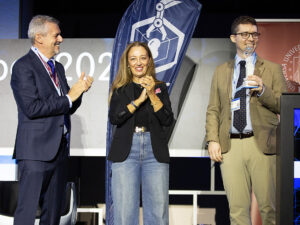
But the day started with Profs. Alberto Breda (Barcelona, ES) and Fabrizio Dal Moro (Padua, IT) welcoming the first of the 1250 expected participants to Padua on behalf of ERUS and the local organising hospital respectively. Prof. Breda hailed the 50 live cases (8 of which long-distance) that would be making up the bulk of the scientific programme. Prof. Dal Moro also took the opportunity to announce the eight finalists who will on Thursday pitch their innovative technological solutions as part of the RUBIC challenge.

Prof. Breda formally opens ERUS26.
The morning’s first live surgery session featured robotic pyeloplasty with nephrolithotomy; partial suprarenalectomy for pheochromocytoma and homolateral partial nephrectomy; a robotic-assisted radical prostatectomy and the first telesurgical case: a multi-port radical prostatectomy with the surgeon in Padua and the patient at the National Medical Institute of the Ministry of Interior and Administration in Warsaw, Poland. (Note: webcasts of this session are already available for ERUS26 delegates in the ERUS26 Resource Centre.)
The moderators were interested to hear from Dr. Pawel Wisz (Warsaw, PL) what his experiences with the Edge Robotic System were, in particular switching between robotic systems (like switching between cars of different manufacturers), latency (practically unnoticeable at distances between European countries) and switching over from remote to local control. Dr. Wisz explained that in his experience this was a matter of “one click, 15 seconds”.
Surgery in the afternoon
That this was perhaps not always the case was demonstrated by the session that started at 14:30. What started as a demonstration of seamless switching between remote and local control and back unfortunately led to the remote surgeon, Dr. Youness Ahallal (Nice, FR) not being able to reconnect as quickly as hoped, with local surgeon Dr. Hamza El Neil (Casablanca, MA) performing a larger part of the prostatectomy case than anticipated. This turned into an insightful discussion with the moderators on the realities of this new field.
Dr. Ahallal explained how he had standardised communication protocols with his assistant so that the experience would be identical working side-by-side or remotely. Teleproctoring was also paying off, with Dr. Ahallal using the opportunities to keep an eye on operations in Casablanca when in Nice and help out when needed. After a few minutes, the connection was restored and controls reverted to Padua, allowing Dr. Ahallal to complete the case. He was aided by an AI algorithm that is designed to minimise jitter and offer a smoother, more consistent experience for the surgeon over long distances when delay becomes noticeable (but manageable).

Dr. Ahallal operating from the ERUS26 venue in Padua.
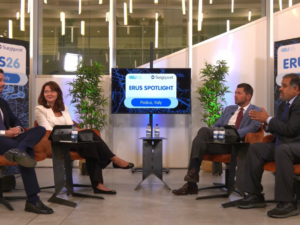
Another case taking place simultaneously was a single-port ureteral reimplantation in ileal conduit, an extremely challenging case performed by Prof. Franco Gaboardi (Milan, IT) in Abano Terme, just outside Padua. With experienced moderators Profs. Massimo Iafrate (Padua, IT) and Joan Palou (Barcelona, ES) following the case, they were quick to offer guidance when the ureter proved challenging to find. Prof. Breda also spoke up from the audience, switching to Italian to remove any language barriers.
Once the challenge was bested, Prof. Palou commended Prof. Gaboardi’s efforts and concluded that such a procedure is “not to be underestimated and certainly not simple. We have to know the patient’s anatomy, need as many tricks as possible to find the ureter, and then all of our skills and knowledge to reconstruct.”
- ERUS26 will continue on September 10th with the RUBIC Session, the ERUS Awards and much more live surgery.


surgery session)